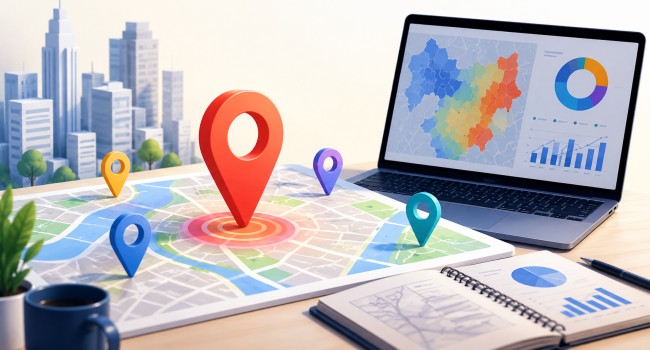
A retail brand runs a campaign for premium running shoes. The targeting looks right — active-lifestyle audiences, sports enthusiasts, people who’ve been browsing fitness content online. The ads get clicks. But store visits don’t move.
Now, picture a different approach. Instead of chasing digital profiles, the campaign uses geomarketing to focus on people who actually go to gyms, running tracks, and sports stores in the same neighborhoods. Ads reach them when they’re nearby — or shortly after they’ve been there.
The shoes haven’t changed. The budget hasn’t either. The ad finally reaches people who are already moving toward a decision.
That’s not a creative breakthrough. It’s not a big expense. It’s what geomarketing does when it’s backed by accurate location data — it puts your brand exactly where your audience already is.
Many marketing strategies still assume intent appears online first.
A homebuyer driving through neighborhoods on a Saturday, stopping into a few real estate offices just to get a feel for things. Someone who’s been thinking about upgrading their phone is finally walking into a store — not to buy yet, just to hold a few in their hands.
A family that’s been meaning to try a new part of town, wandering through a few restaurants before settling on one. And that’s exactly where location data becomes most useful — particularly through POI data.
POI stands for Point of Interest. In the context of marketing and analytics, it refers to structured data about real-world places — stores, restaurants, hospitals, offices, service centers, entertainment venues, and thousands of other locations where people interact daily.
When those places are mapped and studied using location data, they begin to reveal patterns of behavior. And those patterns often say more about intent than digital signals alone.
Why Location Is Where Intent Begins?
Traditional marketing likes neat categories — demographics, household income, lifestyle segments.
But people rarely behave according to categories. They move according to situations.
Think about it. Someone standing inside a home improvement store isn’t there by accident — something around the house probably needs fixing, replacing, or upgrading. A person wandering through a row of car dealerships on a Saturday afternoon is almost certainly weighing options.
Proximity has a way of shaping choices long before anything shows up in a marketing dashboard.
Research indicates that 76% of people who search for something local on their phone walk into a related store within a day, and more than a quarter of those visits end in a purchase.
The takeaway is fairly simple: when people look for something nearby, action tends to follow.
Location data makes those moments easier to identify. And POI data provides the structure — mapping not just where businesses are located, but what kind of environment they represent.
Step 1: Smarter Audience Segmentation with Place-Based Insights
Most audience segmentation still leans heavily on digital behavior. Pages viewed, interests inferred, content consumed.
Location data introduces another dimension: routine.
Where do people spend time in the real world?
Someone who visits fitness centers three times a week probably has different priorities than someone whose weekend routine involves hardware stores and garden centers.
Someone who has driven past the same row of dealerships three weekends in a row isn’t browsing anymore. They’re close to a decision — probably closer than anyone reading comparison articles at home.
Pull back, and you start seeing this everywhere. The same commuter crowds move through the same hubs at the same time every week. Entertainment venues attract clusters of activity on weekends. People falling into routines they don’t even realize they’re in.
Instead of segmenting audiences purely by digital interests, geomarketing helps marketers segment them by real-world behavior.
And that tends to produce more grounded insights.
Step 2: Geofencing for Real-Time, Contextual Engagement
Geofencing is one of the most practical tools in a geomarketing strategy. Once you understand where audiences spend time, the next step becomes more practical: reaching them while context still matters.
Geofencing allows marketers to define virtual perimeters around specific locations — a shopping mall, a stadium, a transit hub, or a group of competitor stores. When devices enter or exit those zones, campaigns can activate.
But geofencing works best when it respects the rhythm of those places.
Someone near a mall on a weekend afternoon may be open to browsing. Someone passing through a train station at rush hour probably isn’t. Location data helps distinguish between those situations.
Buyer behavior trends increasingly reflect this trust in proximity. Research from Think with Google shows that “near me” searches have grown more than 500% in recent years, showing how often people look for businesses based on their immediate surroundings.
People rarely search for “restaurants” anymore. They search for restaurants near them.
Marketing that fits with those moments feels less intrusive — and more useful.
Step 3: Comprehending Consumer Behavior Through Movement
Foot traffic numbers can be misleading on their own.
For example, a sporting goods retailer may share audience overlap with nearby gyms, parks, and outdoor recreation areas. A home improvement store might draw visitors primarily from suburban neighborhoods several miles away rather than the immediate area.
When studied across many POIs, these movements begin to look less like isolated visits and more like behavioral networks.
Cities, in a sense, reveal how people actually live within them.
Step 4: Measuring What Actually Happened
Marketing measurement often stops at digital engagement — impressions, clicks, conversions.
But those signals don’t always show what happened in the real world.
This is where geomarketing earns its place in the budget conversation.
By looking at who saw the marketing campaign and then tracking which group actually showed up, marketers can start connecting advertising spend to real store visits. Not estimated. Not inferred from clicks. Actual footfall.
The numbers back this up. In one survey, 89% of marketers reported a rise in sales after bringing location data into their strategy. A strong sign of how physical-world signals can strengthen both marketing campaign performance and attribution.
Another useful lens is trade area analysis. Businesses often assume their customers come from nearby neighborhoods. In reality, visitors sometimes travel from unexpected areas.
Location data shows those patterns.
Once you see where visitors are actually coming from, marketing strategies — and even expansion plans — tend to shift.
The Foundation: Accurate, Up-to-Date POI Data
All of these understandings rely on something fairly basic: reliable POI data. Reliable POI data makes geomarketing trustworthy at scale — without it, every targeting and measurement decision downstream becomes unreliable.
If locations are outdated or incorrectly categorized, everything built on top of them becomes questionable. A closed store might still appear in targeting. A new location might not yet be included.
Good POI data usually includes:
- Precise geographic coordinates
- Clear business categories
- Brand-level identification
- Regular updates reflecting openings and closures
- Accurate boundaries for physical locations
Privacy-Conscious by Design
Location data understandably raises privacy apprehensions.
Most modern location analytics rely on aggregated and anonymized signals. Instead of tracking individuals, the focus is on more extensive patterns — how groups of devices move through diverse environments.
Responsible geomarketing focuses on patterns rather than individuals — understanding how groups move through places, not tracking who they are.
When location data is used responsibly, it’s handled in accordance with consent frameworks and existing privacy regulations. Done properly, it gives marketers a clearer picture of real-world behavior without jeopardizing privacy.
A Functional Framework for Geomarketing
Building a geomarketing campaign doesn’t require a complicated overhaul.
It usually starts with identifying the places where intent forms in your industry — retail stores, service locations, entertainment venues, or commercial hubs.
From there, location data and POI data can help analyze how customers interact with those environments. Movement patterns display which locations attract similar audiences and how people move between them.
Campaigns can then activate around those places through geofencing and contextual messaging. Measurement focuses on real outcomes — visits, travel patterns, shifts in trade areas.
The strategy becomes less about guessing and more about observing.
The Bigger Shift
For years, marketing has focused heavily on digital behavior. But people still live their lives in physical environments — commuting through cities, visiting stores, meeting friends, exploring neighborhoods. Those movements carry a signal. And that signal has largely gone uncaptured.
Geomarketing changes that. Location data and POI data give it structure. Together, they bring the physical world back into marketing strategy — not as a vague concept, but as something measurable, actionable, and increasingly essential.
Because sometimes, understanding where people go is the clearest indicator of what they want next.
Ready to make geomarketing the sharpest move in your marketing strategy? See how location data and POI data can sharpen your targeting, segmentation, and attribution.
Also Read: