

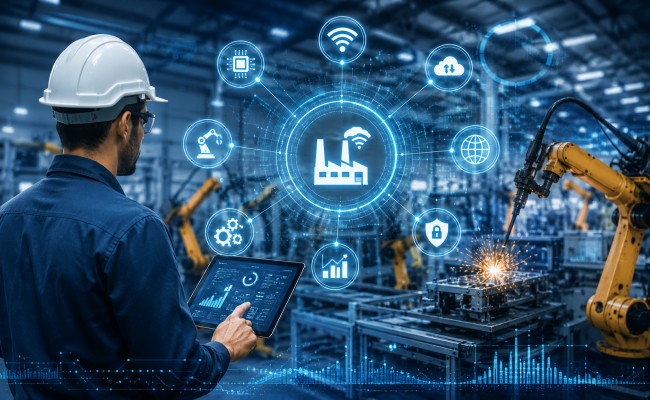
On a global scale, we are observing a new wave of development, propelled by technology and enhanced human knowledge and skill. An eye-catching technological concept that is signifying this rapid growth is the Industrial Internet of Things.
The Industrial IoT is being implemented effectively across multiple sectors, such as inventory management, and supply chain information Industry experts in this field estimate that investing in automation in most industrial processes will completely negate the risk of errors in the system.
It is a common notion that IIoT is transforming how industries function and it is opening paths for them to welcome the new age of automation and smart industry solutions across multiple business verticals. It encourages a cycle of generating employment, optimising inputs, and raising revenue.
Industrial Automation growth can be employed with its own processes like energy production, mining operations, and construction. Manufacturing is one of the sectors that is leveraging the IIoT. Here are some significant applications of the Internet of Things in the manufacturing sector:
1. Predictive Maintenance: Fixing Problems That Haven’t Happened Yet
Calendar-based maintenance was always an educated guess dressed up as a system. Service every 90 days whether the machine needs it or not. Sometimes that means wasted maintenance hours on perfectly healthy equipment. More dangerously, it misses the bearing that quietly degraded on day 47.
IIoT sensors embedded in motors, conveyor systems, and hydraulic units continuously monitor vibration signatures, thermal output, and pressure fluctuations. Anomalies register in real time. When a motor’s vibration pattern starts trending toward a historical failure signature, the alert goes out — hours or days before the breakdown materializes.
Siemens has deployed predictive maintenance architectures across multiple global facilities, reporting dramatic reductions in unplanned downtime. The operational arithmetic is simple: one prevented shutdown often recovers the full cost of the sensor infrastructure that caught it.
2. Supply Chain Visibility: Knowing Where Everything Is, Always
Most supply chain failures aren’t dramatic. They’re slow bleeds — a raw material that arrived two days late, an inventory count nobody updated, a reorder trigger that fired too late because someone checked the wrong spreadsheet. IIoT closes those gaps with infrastructure that removes human lag from the equation.
RFID-tagged components, connected pallets, and smart storage systems transmit location and quantity data continuously. Procurement teams receive automated alerts when stock approaches critical thresholds. Inbound shipments are tracked with enough precision that production scheduling adjusts before shortages create floor-level chaos.
McKinsey & Company found that connected supply chain technologies can reduce inventory holding costs by up to 30% while simultaneously improving fulfillment speed. That combination — lower cost, faster delivery — is exactly what margin-pressured manufacturers need.
3. Quality Control That Doesn’t Fatigue
Human inspection at scale has a ceiling. A trained quality inspector brings expertise and judgment to the line, but also fatigue after hour six, and attention that frays when volume spikes. IIoT-integrated vision systems and precision sensing don’t have those limitations.
Dimensional tolerances, surface defects, fill levels, seal integrity — these get measured in milliseconds across every unit moving down the line.
When a batch drifts outside acceptable parameters, the system flags it, isolates the affected units, and in advanced configurations, adjusts upstream process variables without waiting for manual review. Defects stop accumulating across entire batches and get caught at the point of origin.
4. Energy Management With Actual Teeth
Energy efficiency targets often exist as aspirational language in corporate sustainability reports. IIoT gives those targets teeth. Sensors across lighting systems, HVAC units, compressed air networks, and production equipment feed consumption data into centralized platforms that surface patterns no energy audit could catch at this granularity.
Idle equipment drawing full power during shift transitions — visible. Compressed air leaks bleeding 20% efficiency from the pneumatic system — detectable. Peak demand windows inflating utility costs unnecessarily — manageable.
The International Energy Agency identifies smart manufacturing technologies as holding substantial potential for reducing industrial energy intensity, and the facility-level data bears that out.
5. Worker Safety That Goes Beyond Posted Signage
Safety programs built on laminated posters and annual training sessions represent the floor of compliance, not genuine protection. IIoT raises that standard considerably.
Wearable devices monitor fatigue indicators and ergonomic stress in physically demanding roles. Environmental sensors detect air quality degradation, gas accumulation, and temperature spikes before conditions become dangerous.
Geofencing alerts workers and supervisors the moment someone enters a restricted machine zone. Near-miss incidents — historically underreported because reporting them requires paperwork and sometimes uncomfortable conversations — get captured automatically through sensor data.
The safety record improves not because people try harder, but because the system removes the conditions that produce incidents.
6. OEE: The Metric That Finally Gets Real Data
Overall Equipment Effectiveness sits at the center of manufacturing performance measurement. Historically, OEE calculations relied on shift reports compiled after the fact — data with gaps, estimates, and the natural human tendency to round numbers favorably.
IIoT feeds availability, performance, and quality rate data into OEE calculations continuously and without interpretation. Managers see exactly where bottlenecks form, which machines run below rated capacity, and when rejection rates spike.
That specificity compresses the cycle between identifying a problem and acting on it. Deloitte Insights puts potential productivity improvements for IIoT-driven smart factory initiatives at 10–20% in high-volume production environments — numbers that don’t emerge from incremental process tweaks.
The Decision Behind the Data
Every factory already generates enormous amounts of operational data. Machines produce it, workers encounter it, and systems touch it constantly. The question IIoT answers isn’t whether data exists — it’s whether that data gets captured, connected, and acted on before problems compound.
Manufacturers who treat connected infrastructure as optional are making a choice, even if it doesn’t feel like one. The facilities benchmarking against them made a different choice earlier. That gap doesn’t close easily.
Also Read:

1 comment
Awesome blogs.. Getting upto date information..