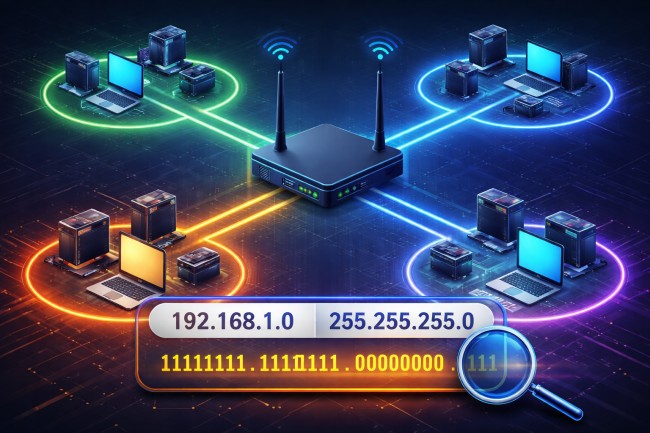
A subnet mask looks modest. Four numbers. No drama. Yet it decides how networks grow, shrink, isolate, and survive. Every packet checks it. Every router trusts it. Every serious network design bends around it.
Subnet masks exist to impose order. Without them, IP addressing turns sloppy, broadcasts flood links, and routing logic fractures. With them, networks stay lean, predictable, and scalable. Here in this article, we will discuss what exactly is subnet masks, from definition to design logic.
What a Subnet Mask Really Is
A subnet mask is a 32-bit value used alongside an IPv4 address. Its purpose is separation. One part of the address identifies the network. The remaining part identifies individual devices inside that network.
An IP address without a subnet mask lacks context. Systems cannot determine which destinations are local and which require routing. The subnet mask provides that boundary.
Example:
- IP address:
192.168.20.34 - Subnet mask:
255.255.255.0
This pairing states that all addresses sharing the first three octets belong to the same network segment.
Why Subnet Masks Exist
Early networks grew fast and broke faster. Flat addressing created congestion. Broadcast traffic multiplied. Administration turned reactive.
Subnet masks were introduced to solve structural problems:
- Control broadcast scope
- Segment large address spaces
- Improve routing decisions
- Reduce IP waste
Subnetting changed networks from open fields into planned districts. Traffic stayed local. Growth became measurable.
Binary Logic Behind a Subnet Mask
Subnet masks operate on binary rules. That fact scares beginners. It should not.
Each IPv4 address contains 32 bits. A subnet mask also contains 32 bits.
- Binary 1 marks a network bit
- Binary 0 marks a host bit
Example in binary:
IP address:   192.168.1.10
Binary:       11000000.10101000.00000001.00001010

Subnet mask:  255.255.255.0
Binary:       11111111.11111111.11111111.00000000
Bits aligned with ones remain fixed. Bits aligned with zeros vary. That line defines the subnet.
Decimal Representation and Valid Values
Subnet masks appear in dotted decimal form for readability. Each octet represents eight bits.
Only specific values occur:
0, 128, 192, 224, 240, 248, 252, 254, 255
These values exist because network bits must remain contiguous. Gaps break routing logic.
A value like 255.255.240.0 works. A value like 255.0.255.0 does not.
CIDR Notation Explained
CIDR notation compresses subnet masks into a simpler format. Instead of writing all four octets, CIDR shows the count of network bits.
Examples:
/8equals255.0.0.0/16equals255.255.0.0/24equals255.255.255.0/27equals255.255.255.224
CIDR removed rigid address classes. Network sizes became adjustable. Precision replaced guesswork.
Modern networks rely on CIDR almost exclusively.
IP Address Classes and Historical Context
Before CIDR, IP addressing followed fixed classes.
Class A
- Default mask:
255.0.0.0 - Huge host count
- Few networks
Class B
- Default mask:
255.255.0.0 - Balanced structure
Class C
- Default mask:
255.255.255.0 - Small networks
Classful design no longer governs real networks, yet the mental framework still helps when reading legacy documentation.
Subnet Mask and Host Capacity
A subnet mask directly controls how many devices fit inside a subnet.
Formula:
Usable hosts = 2^(host bits) − 2Two addresses are reserved:
- Network address
- Broadcast address
Examples:
/24→ 254 usable hosts/25→ 126 usable hosts/26→ 62 usable hosts/30→ 2 usable hosts
Smaller subnets reduce noise. Larger subnets permit growth. Balance matters.
Network Address and Broadcast Address
Every subnet reserves two non-assignable addresses.
Network Address
The first address in the subnet. All host bits set to zero. Identifies the subnet itself.
Example: 192.168.1.0/24
Broadcast Address
The last address in the subnet. All host bits set to one. Reaches every device in that subnet.
Example: 192.168.1.255/24
Assigning either to a host creates silent failures that waste hours.
Subnetting in Practice
Subnetting follows structure, not instinct.
- Define required subnets or host counts
- Borrow bits from the host portion
- Calculate block size
- List subnet ranges
Example:
Base network: 192.168.1.0/24
Required subnets: 4
Borrow 2 bits → /26
Block size: 64
Resulting subnets:
192.168.1.0 – 63192.168.1.64 – 127192.168.1.128 – 191192.168.1.192 – 255
Each behaves independently.
Variable Length Subnet Mask (VLSM)
VLSM allows different subnet sizes within the same address space.
Uniform sizing wastes addresses. Real networks rarely grow evenly.
VLSM supports:
- Tight point-to-point links
- Medium user networks
- Large service segments
This flexibility improves address efficiency and reduces redesign pressure later.
Enterprise and cloud networks depend on VLSM.
Subnet Masks in Routing Logic
Routers make decisions using subnet masks.
Process flow:
- Apply subnet mask to destination IP
- Compare against routing table entries
- Select the most specific match
This behavior is known as longest prefix match.
A route with /28 overrides a route with /24. Precision wins.
Subnet Mask, IP Address, and Default Gateway
These three values operate as a set.
- IP address identifies the host
- Subnet mask defines the local boundary
- Default gateway routes external traffic
Mismatch between them breaks connectivity even when hardware remains healthy.
Private IP Addressing and Subnet Masks
Private networks rely heavily on subnetting.
Common private ranges:
10.0.0.0/8172.16.0.0/12192.168.0.0/16
Subnet masks carve these spaces into logical units for departments, services, and environments.
Address planning here prevents chaos later.
Subnet Masks in Cloud Architecture
Cloud networks treat subnet masks as design primitives.
Subnets control:
- Workload isolation
- Routing paths
- Security policy boundaries
Poor subnet planning in the cloud leads to overlapping ranges, blocked peering, and forced rebuilds.
Clean architecture begins with clean subnets.
Common Subnet Mask Mistakes
Errors happen quietly and hurt later.
- Oversized subnets inflate broadcast traffic
- Undersized subnets restrict growth
- Overlapping CIDR blocks break routing
- Incorrect prefix length causes unreachable hosts
Subnetting rewards patience. Guessing invites outages.
Checking Subnet Masks on Systems
Subnet information is easy to inspect.
- Windows:
ipconfig - Linux:
ip addr - macOS:
ifconfig
Subnet mask appears alongside the IP address.
Subnet Masks and IPv6
IPv6 removes dotted decimal masks but preserves the concept.
Prefix lengths replace subnet masks. /64 is the standard subnet size.
The idea remains unchanged. The scale expands dramatically.
Why Subnet Masks Still Matter
Subnet masks remain central to networking.
They shape routing logic, security boundaries, and scalability. Misunderstanding them leads to brittle systems. Mastery leads to predictable growth.
Once subnet masks make sense, networking stops feeling abstract and starts behaving logically.
Closing Perspective
A subnet mask is not decoration. It is discipline.
It defines structure inside networks. It controls reach, order, and efficiency. Used correctly, it keeps systems calm under pressure. Used poorly, it creates invisible failures.
Understanding subnet masks removes mystery from networking. Everything else builds on that foundation.
Also Read: