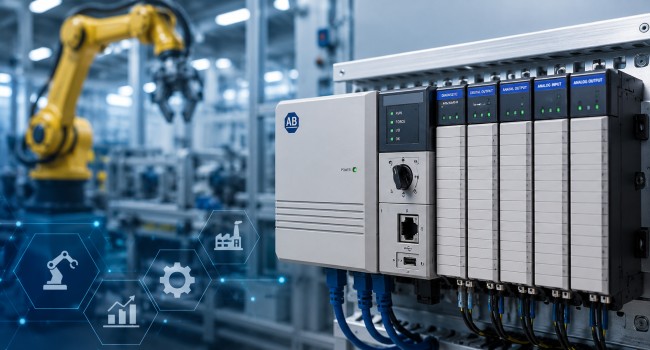
Walk through a modern manufacturing plant and you’ll probably notice the robots first.
Conveyors glide past with perfect timing. Machines stamp, cut, package, and inspect products without hesitation. Pallets seem to appear exactly where they’re supposed to. Everything feels almost choreographed, as if the factory somehow knows what happens next before it actually does.
In a way, it does.
Hidden inside control cabinets across the facility are programmable logic controllers, or PLCs, quietly making thousands of decisions every second. They’re not flashy. Nobody stops to admire them during a factory tour. Yet if one suddenly stopped working, production might grind to a halt faster than anyone would like.
Among the many control platforms found on factory floors, the Allen Bradley PLC has earned an especially loyal following. Ask ten automation engineers why, and you’ll probably hear ten slightly different answers. Reliability usually tops the list.
Familiarity isn’t far behind. Then there’s the simple reality that when something works exceptionally well for decades, industries tend to keep using it.
The Small Computer Doing the Heavy Lifting
At its heart, a PLC is an industrial computer built for one purpose: controlling machines.
It constantly monitors information coming from sensors, switches, buttons, and instruments, processes that information according to a programmed set of instructions, and then tells motors, pumps, valves, conveyors, or robotic equipment exactly what to do next.
It all happens remarkably fast.
Check the inputs. Run the logic. Update the outputs.
Repeat. Again. And again.
Thousands of times every minute without anyone standing nearby flipping switches.
According to the National Institute of Standards and Technology, industrial automation plays a major role in improving manufacturing productivity, product consistency, and operational efficiency across modern production environments.
Why Allen Bradley PLCs Became So Common
Factories don’t usually enjoy taking risks.
Replacing automation equipment isn’t like upgrading a smartphone. Production lines often operate around the clock, and even a short interruption can become surprisingly expensive.
That’s one reason Allen Bradley PLCs remain so widely installed.
They’ve built a reputation over many years for dependable performance, and once a platform proves itself in demanding industrial environments, companies are understandably reluctant to change.
Several factors continue to support their popularity:
- Reliable operation in demanding environments
- Scalable systems for facilities of different sizes
- Broad compatibility with industrial equipment
- Extensive technical documentation
- Large communities of experienced automation professionals
There’s also something engineers quietly appreciate: finding people who already know how to work with the platform tends to be much easier when it’s been an industry staple for decades.
You Encounter PLCs More Often Than You Think
Most people never actually see a PLC.
They see the results.
They’re working behind the scenes in:
- Automotive assembly plants
- Food and beverage facilities
- Water and wastewater treatment plants
- Distribution centers
- Packaging operations
- Pharmaceutical manufacturing
- Energy facilities
- Material handling systems
If a machine automatically starts, stops, sorts, fills, mixes, or packages something, there’s a good chance a PLC is involved somewhere in the process.
Programming Isn’t as Mysterious as It Sounds
The word programming sometimes scares people away.
It really shouldn’t.
Many PLCs use a language called ladder logic, which intentionally resembles traditional electrical relay diagrams. Electricians and maintenance technicians often find it much easier to understand than conventional software code because the logic visually reflects familiar electrical control circuits.
Modern controllers certainly support more advanced programming languages as well.
But the objective hasn’t changed.
Make automation reliable. Make troubleshooting easier. Keep production moving.
Simple goals, really.
The Real Test Comes Years Later
Installing automation equipment is only the beginning of the story.
The more interesting question is this:
What happens ten or twenty years later?
Many manufacturing facilities continue operating older equipment because it still performs its job effectively. Replacing an entire control system simply because it’s aging can involve significant costs, extended downtime, employee retraining, and production disruptions.
That’s why replacement parts, repair services, and legacy hardware support remain incredibly valuable. Extending the life of existing automation often makes far more business sense than replacing equipment that’s still doing exactly what it was designed to do.
Factories Are Getting Smarter, PLCs Are Evolving Too
Today’s industrial facilities generate enormous amounts of information.
Production data. Maintenance alerts. Quality metrics. Energy usage.
Modern PLCs increasingly connect with human-machine interfaces, industrial networks, remote monitoring systems, and plant-wide data platforms, allowing manufacturers to make faster decisions based on real-time information.
The International Society of Automation continues developing standards and best practices that support safe, efficient, and reliable industrial automation around the world.
The technology evolves.
The mission stays remarkably consistent.
The Quiet Technology Behind Every Busy Factory
Nobody visits a manufacturing plant hoping to admire a control cabinet.
Yet without PLCs, much of modern automation simply wouldn’t function.
The Allen Bradley PLC has earned its reputation not because it’s flashy, but because it has repeatedly demonstrated the qualities industrial facilities value most: dependable operation, flexibility, and long-term support. In an environment where every minute of production matters, those qualities are difficult to overstate.
Sometimes the most important technology is the technology nobody notices, at least until it stops working.
Also Read: