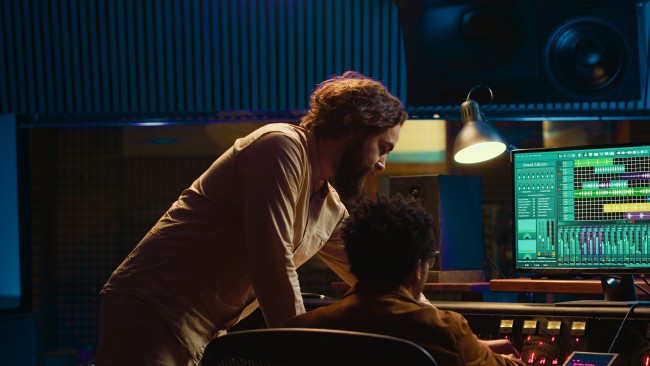
There was a time when sounding professional meant spending like a professional. A vintage Neve console. Rack-mounted outboard gear. A Studer tape machine.
The hardware chain alone, before a single microphone was purchased, cost more than most people’s annual income. Music production at commercial quality was, for most of history, a capital-intensive business with steep entry barriers.
VST plugins dismantled that gatekeeping almost entirely. Virtual Studio Technology — originally developed by Steinberg in 1996 — created a standard for software instruments and audio processors to run inside a Digital Audio Workstation as virtual equivalents of physical gear.
What followed was three decades of increasingly sophisticated software that now competes with, and in many cases outperforms, the hardware it originally emulated.
The global audio plugins market hit $1.62 billion in 2024, growing at a 9.1% CAGR toward a projected $3.62 billion by 2033, according to DataIntelo’s audio plugins market analysis.
More than 87% of professional studios have integrated VST-based plugins as primary production tools, per Market Growth Reports. The investment case is not theoretical — it is being validated daily in studios ranging from bedroom setups to commercial facilities producing chart-level work.
Here is why the case holds up under scrutiny.
1. The Cost Gap Between Software and Hardware Is Enormous
Comparison shopping between hardware and VST equivalents produces numbers that are difficult to argue with. A hardware analogue synthesizer with serious sonic credentials — a Minimoog, an Oberheim OB-X, a Roland Jupiter-8 — commands anywhere from $5,000 to $30,000 in the current secondhand market.
These instruments are finite, increasingly scarce, and require specialist maintenance that becomes harder to source every year.
Arturia’s V Collection contains meticulously modelled software versions of over 40 instruments from that era — including the Minimoog, Oberheim, and Jupiter — for approximately $499 as a complete bundle.
The modelling methodology involves the same component-level analysis used by hardware restoration engineers. The sonic results are, in blind listening tests conducted by publications including Sound On Sound, consistently rated alongside the originals.
Hardware also carries costs that VST ownership does not. Physical space. Power consumption. Preventive maintenance. The ever-present risk of a critical component failing mid-session.
A plugin purchased in 2018 from a developer with an active update policy is, in 2026, a more capable product than it was at launch — and still does not require a technician to keep it running.
That inversion of the usual depreciation curve is one of the most underappreciated financial arguments for building a software-based production environment.
2. Software Does Things Hardware Physically Cannot
The analogue-versus-digital debate in audio has consumed enormous column inches. Less discussed is the category of things software achieves that hardware has no structural mechanism to replicate — and this is where the VST investment argument extends well beyond cost.
Consider convolution reverb. Altiverb by Audio Ease captures the acoustic impulse response of real physical spaces — concert halls, cathedrals, scoring stages — and allows that acoustic fingerprint to be applied to any audio signal with precision that no physical hardware unit can match.
A producer in Dublin can, within seconds, place a vocal in the exact acoustic environment of the Sydney Opera House. That is not an approximation. It is a mathematically accurate acoustic model derived from measurements taken on-site.
Spectral processing, granular synthesis, physical modelling, generative sequencing — these are categories where software’s computational flexibility produces results that sit entirely outside the hardware paradigm.
iZotope’s RX for audio repair removes noise, clicks, reverb, and interference from recordings in ways that would have required multiple expensive hardware units and significant manual effort a decade ago.
49% of new plugins in 2024 incorporated AI-driven features, per Business Research Insights, and that proportion is rising as machine learning models become a standard component of plugin architecture.
3. Workflow Efficiency That Pays Back Every Session
Hardware has a fundamental recall problem. A mix built on a console with outboard gear — compressor settings dialled in, EQ curves shaped across multiple units, reverb sends balanced — must be photographed, notated, and still accepted as imperfectly reconstructable the next day.
A fully ITB (in-the-box) session recalls to the exact same state every time, every parameter exactly as it was, regardless of whether the session was last opened yesterday or three years ago.
That recall precision compounds across a working producer’s output. No session rebuild time. No approximation. No client sessions that cannot be resumed cleanly. The time saved across a year of production work represents a meaningful productivity gain that directly affects commercial output.
AI-driven tools have extended this efficiency further still. Automated mixing assistance, intelligent preset selection based on source material analysis, and smart gain staging have collectively reduced repetitive mechanical workload by nearly 38% for professional users in 2024, according to Global Growth Insights.
FabFilter’s AI-assisted EQ matching was adopted by 68% of mastering studios by the end of that year. These tools do not replace producer judgment — they eliminate the parts of the process that do not require it.
Subscription models from platforms like Splice and storefronts like Plugin Boutique have also changed the economics of building a plugin library. Rent-to-own arrangements let producers access and evaluate tools at manageable monthly costs, converting to permanent ownership selectively.
46% of new customers in 2024 opted for bundled subscription access rather than individual purchases, per Global Growth Insights — a shift that makes professional-grade toolkits accessible without requiring large upfront capital.
4. A Studio That Fits in a Backpack
Hardware studios are fixed. They occupy a room, require controlled acoustic treatment, and stop working the moment a key component develops a fault. A laptop with a well-curated plugin library is a fully functional professional studio that travels anywhere with its owner.
This portability has reshaped who can produce at professional standard. The independent music producer population grew 34% in the past two years as software tools eliminated studio access as a prerequisite for commercial-quality output, per Market Growth Reports.
Over 68% of global audio production now runs through digital plugin ecosystems, and over 5.8 million tracks were mixed using plugins in 2024 alone.
Live performance has followed. Plugin latency dropped approximately 27% in 2024 through developer optimisation, per Global Growth Insights, making VST instruments viable for real-time performance contexts where earlier software generations could not reliably compete with the zero-latency response of hardware.
Touring acts from solo electronic artists to orchestral productions now route significant live audio through software instruments and effects processors.
5. The Library Appreciates Rather Than Depreciates
Hardware ages. Capacitors fail. Calibration drifts. Discontinued components become impossible to source. A vintage synthesizer purchased in 2005 may or may not be fully functional in 2026, and finding a qualified technician is progressively harder as the engineers who built that knowledge base retire.
A well-chosen plugin from a stable developer does the opposite over time. Waves, Universal Audio, and Native Instruments maintain active update cycles on their catalogues — improving performance, adding features, and maintaining DAW compatibility as operating systems evolve.
A plugin purchased seven years ago from any of these developers is, in practical terms, a better and more capable tool today than it was at launch.
The knowledge invested in mastering specific plugins also appreciates. A producer who has spent years understanding the signal flow inside FabFilter’s Pro-Q 3, or built complex modulation architectures in Xfer Records’ Serum, carries skills with direct professional market value.
Plugin fluency — the depth of understanding that comes from sustained investment in specific tools — has become a meaningful component of a modern producer’s professional credentials in ways that general hardware familiarity never quite replicated.
What the Investment Actually Buys
Building a serious VST library is not about accumulating the largest possible collection. It is about acquiring tools that solve real production problems with the precision and reliability that professional work demands — and doing so at a cost structure that would have been unimaginable to producers working a generation earlier.
The market trajectory toward $3.62 billion by 2033, the near-universal adoption across professional studios, and the compounding productivity gains from AI-enhanced tools all point in the same direction.
VST plugins are not a substitute for professional music production. They are what professional music production runs on.
Also Read: