Most traders who lose money on options did not misread the market. They bought a call, Bitcoin moved in the direction they expected, and they still lost.
The premium evaporated faster than the price move could recover it, or implied volatility collapsed after the event they were positioned for, taking the option’s value with it.
Crypto options trading explained properly requires understanding not just what an option is, but why it behaves the way it does under conditions that confuse traders who approach it the same way they approach a spot or futures position.
The Contract Structure: Rights Without Obligations
An option is an agreement between two parties where one buys a right and the other accepts a corresponding obligation. The buyer pays a premium upfront. In exchange, they receive the right to transact a specified asset at a pre-agreed price, called the strike price, on or before a defined expiry date.
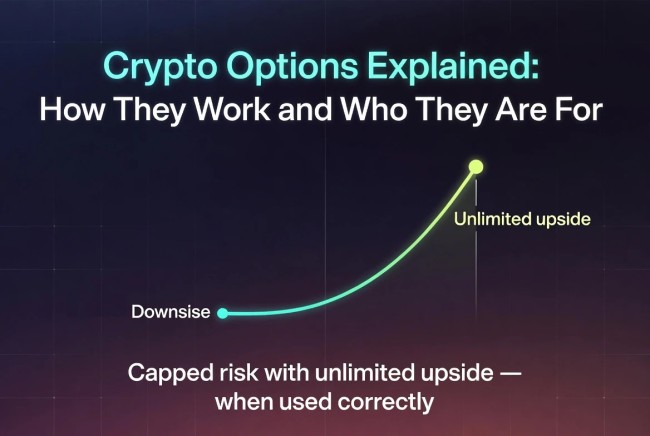
The key word is right: the buyer can choose whether to exercise, and if the option expires worthless, their loss is capped at the premium paid.
A call option gives the buyer the right to purchase the asset at the strike price. It gains value when the asset’s market price rises above the strike. A put option gives the buyer the right to sell at the strike price.
It gains value when the market price falls below the strike. In both cases, the buyer’s downside is limited to the premium. The seller collects that premium and takes on the obligation: to sell at the strike if the call buyer exercises, or to buy at the strike if the put buyer exercises.
The asymmetry is the defining feature. A call buyer on Bitcoin with a $70,000 strike who paid $1,500 in premium cannot lose more than $1,500, regardless of how far Bitcoin falls.
If Bitcoin rises to $85,000, the option is worth $15,000 and the buyer has made $13,500 net. No stop-loss had to be managed. No margin was at risk of liquidation. The loss was defined the moment the premium was paid.
The Four Parameters That Define Every Option
Every option contract is specified by four variables, and changing any one of them changes the option’s price and behaviour substantially.
The underlying asset determines which cryptocurrency the option covers. Bitcoin and Ethereum have the deepest options markets in crypto, with total open interest regularly exceeding $10 billion across both assets on Deribit, the dominant global venue. Other assets have options markets of varying depth and liquidity.
The strike price sets the level the asset must reach for the option to have intrinsic value at expiry. An option is described as in-the-money when the asset is already past the strike in the profitable direction, at-the-money when the asset price equals the strike, and out-of-the-money when the strike has not been reached. Out-of-the-money options are cheaper but require a larger move to generate any intrinsic value.
The expiry date sets the time remaining. Options decay in value as expiry approaches, all else equal, because there is less time for the asset to reach the strike. This decay, measured by the Greek letter theta, accelerates in the final weeks before expiry. A trader who buys an option and holds it too long can watch their premium erode even if the price gradually moves in the right direction.
The option type, call or put, determines which direction of price move is profitable. Everything else flows from these four parameters.
Implied Volatility: the Variable Most Traders Underestimate
The premium of an option is not simply a function of how far the strike is from the current price and how much time remains. It is also a function of the market’s expectation of future price volatility, expressed as implied volatility (IV).
When IV is high, options are expensive. When IV is low, they are cheap. This creates a counterintuitive dynamic that catches new options traders repeatedly.
Major scheduled events, Federal Reserve decisions, Bitcoin halving dates, significant protocol upgrades, cause IV to spike before the event as participants pay up for options to position for a large move.
When the event resolves, whether the price moved significantly or not, IV collapses. This collapse, called IV crush, destroys option premium rapidly.
A trader who bought a call before a major announcement, correctly anticipated the price direction, and still lost money typically experienced IV crush: the drop in IV more than offset the gain from the price move.
The practical lesson is to check IV before buying any option. If IV is already elevated relative to its historical range for that asset, buying options means paying a premium for volatility expectations that may already be priced in.
Selling options, or using spread structures that reduce the net premium paid, becomes comparatively more attractive when IV is high.
| IV condition | Implication for option buyers | Implication for option sellers |
| IV low vs historical | Options cheap, premium affordable | Selling options offers less income |
| IV high vs historical | Options expensive, premium elevated | Selling options offers more income |
| IV crushing post-event | Damages long option positions | Benefits short option positions |
| IV rising pre-event | Benefits existing long options | Damages existing short options |
Who Options Are Actually For
Three distinct user types approach crypto options with genuinely different objectives, and the instrument that serves one well serves another poorly.
Speculators use options to get directional exposure to price moves with a defined maximum loss. The appeal relative to spot or futures is the hard floor on downside.
A trader with strong conviction on a Bitcoin rally who does not want open-ended downside exposure can buy a call, know exactly what they stand to lose if wrong, and retain unlimited upside if right.
The tradeoff is that time decay and IV work against the buyer constantly: the position starts losing value the moment it is entered if price does not move quickly enough in the right direction.
Hedgers use put options to protect existing positions without selling them. A Bitcoin holder who wants to preserve exposure to a potential rally but cannot stomach a 30% drawdown can buy put options at a strike below the current price.
If Bitcoin falls sharply, the puts gain value and offset the loss on the underlying position. If Bitcoin rallies, the puts expire worthless and the holder retains the full gain.
This structure, often called a protective put, is how miners and long-term holders manage downside risk during uncertain periods without reducing their actual Bitcoin holdings.
Income generators sell options rather than buying them. A holder of Bitcoin who sells call options above the current price collects premium upfront. If Bitcoin stays below the strike at expiry, the option expires worthless and the seller keeps the premium as income.
If Bitcoin rises above the strike, the seller may be obligated to sell at the strike price, capping their upside but having already collected the premium. This covered call strategy trades unlimited upside for recurring income, which suits holders with lower conviction on near-term price moves.
Reading the Options Market as a Sentiment Tool
Beyond their use as trading instruments, crypto options provide a real-time sentiment reading that pure price data cannot replicate. The options skew, which compares implied volatility between calls and puts at equivalent distance from the current price, reveals whether the market is paying more for upside or downside protection.
When call skew exceeds put skew, participants are paying a premium for upside exposure above the current price. That premium reflects bullish positioning at the institutional level, not just retail enthusiasm that shows up in social media sentiment.
When put skew dominates, the market is actively paying for downside insurance, which reflects fear of decline among participants sophisticated enough to use options for hedging.
Open interest distribution across strikes shows where large positions are concentrated, which can influence price behaviour near expiry as market makers hedge their exposure and large option positions create gravitational effects around heavily traded strikes.
Traders who monitor options market data alongside price charts are operating with a more complete picture of market structure than those who look at price alone.
Conclusion
Crypto options are simultaneously the most flexible instrument in the market and the most frequently misused. The flexibility comes from the asymmetric payoff: capped downside, open upside for buyers, with controllable risk structures available through multi-leg combinations.
The misuse comes from treating them like directional bets without accounting for time decay and implied volatility.
A trader who understands those two forces, and who knows whether they are speculating, hedging, or generating income before they enter an options position, is working with the instrument as it is designed to be used.
Everyone else is paying premium they do not fully understand for exposure they cannot fully evaluate.
Also Read: