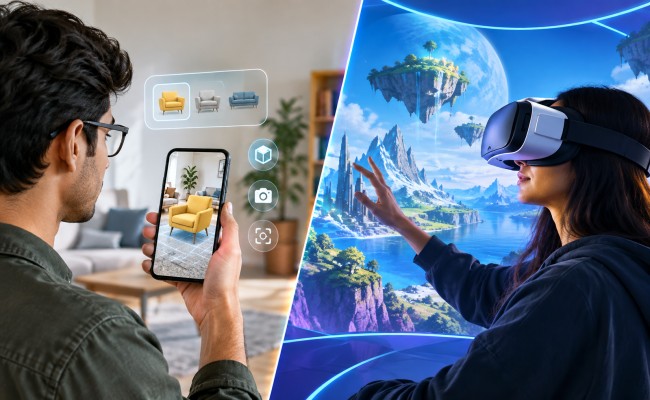
AR and VR are easy to confuse. Both use computer-generated content, both are found in gaming and business, and both can create experiences that feel very different from ordinary screens. That is where the similarity largely ends.
Augmented reality (AR) keeps the real world in view and adds digital elements to it. Virtual reality (VR) takes the user into a computer-generated environment instead. One adds to reality. The other creates a new setting altogether.
That difference matters when businesses decide where the technology can actually be useful.
What Is Augmented Reality?
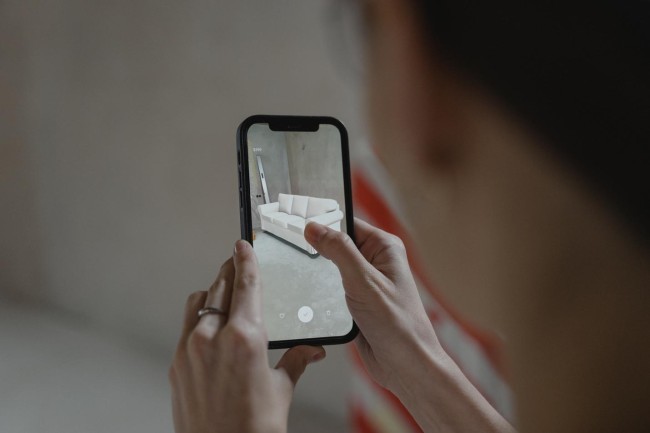
AR does not ask people to leave their surroundings behind. Instead, it puts digital information over the physical environment.
A smartphone camera is enough for many basic AR applications. More advanced systems use smart glasses, cameras and sensors to recognise surfaces, movement and objects around the user.
Consider furniture shopping. An AR app can show how a sofa might look in a living room before an order is placed. The room remains real; the sofa is the digital addition.
The same idea works in business.
Common AR applications include:
- Product visualisation in retail
- Interactive advertising campaigns
- Navigation and location-based information
- Equipment repair instructions
- Industrial maintenance
- Classroom demonstrations
- Virtual product try-ons
For technicians and field workers, AR can be particularly practical. Instructions can appear while the actual machine stays in front of the worker. There is less need to switch constantly between equipment and a separate manual or screen.
What Is Virtual Reality?
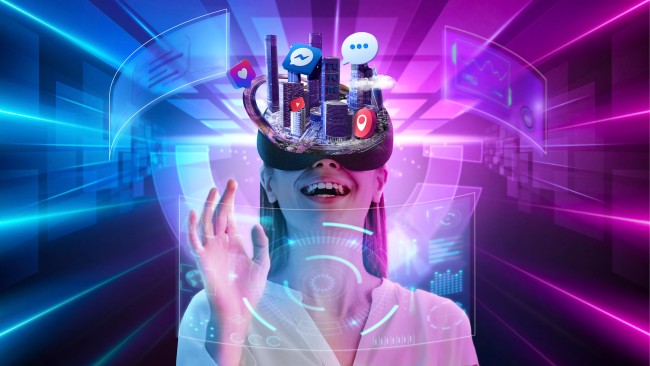
VR takes a much bigger step away from the physical surroundings.
A VR headset creates a computer-generated environment that surrounds the user. Looking left, right, up or down reveals different parts of that virtual space. Controllers or hand-tracking technology can then be used to interact with objects inside it.
Gaming remains one of the most familiar VR applications, but entertainment is only part of the story.
Companies can use VR for employee training, safety exercises, equipment simulations and customer experiences. A trainee can practise a procedure in a simulated environment without requiring access to the real equipment every time.
That changes the economics of certain types of training. A dangerous situation can be recreated without putting people in danger. An expensive machine does not need to be taken offline for every practice session.
AR vs. VR: What Is the Actual Difference?
The easiest way to separate AR and VR is to look at what happens to the physical world.
| Feature | Augmented Reality | Virtual Reality |
|---|---|---|
| Real surroundings | Remain visible | Mostly blocked out |
| Digital content | Added to the real world | Forms the main environment |
| Typical hardware | Phones, tablets, smart glasses | VR headsets and controllers |
| Best suited for | Assistance and visual information | Simulation and immersion |
| Example | Seeing furniture inside a real room | Exploring a completely virtual room |
There is also mixed reality (MR), which sits between the two. Digital objects can appear within a physical environment and interact with it in more advanced ways.
So the terms are related, but they are not interchangeable.
How Can Businesses Use AR?
AR makes sense when the physical environment is still part of the job.
A retailer could allow customers to preview products at home. A manufacturer could place digital instructions beside machinery. An engineer could receive visual information about a component without walking away from the equipment.
Marketing teams have another reason to consider AR. Interactive campaigns can turn a standard advertisement into something customers can actually engage with. The technology becomes part of the experience rather than another banner competing for attention.
There is a practical side too. In some workplaces, reducing the need to consult printed manuals or separate screens can make routine tasks quicker.
How Can Businesses Use VR?
VR is better suited to situations where a simulated environment is the point.
Employee training is a clear example. Instead of sitting through another presentation about workplace safety, employees can practise responding to a simulated incident.
Other uses include:
- Medical and healthcare training
- Aircraft and vehicle simulations
- Workplace safety exercises
- Virtual property tours
- Engineering design reviews
- Gaming and entertainment
- Customer demonstrations
VR also opens possibilities for remote collaboration. Teams in different locations can enter the same virtual space and work with digital models, depending on the hardware and software involved.
AR or VR: Which One Makes Sense?
There is no universal winner because the technologies solve different problems.
AR is generally more suitable when:
- The real environment needs to remain visible.
- Digital instructions are required during physical work.
- Products need to be visualised in real locations.
- Mobile devices or lightweight wearables are preferred.
VR is generally more suitable when:
- Full immersion is required.
- Training needs a realistic simulation.
- The real environment is expensive, dangerous or difficult to recreate.
- A completely digital experience is the main objective.
The distinction comes down to one basic question: should digital content be added to the real world, or should the real world be replaced for the experience?
AR chooses the first approach. VR chooses the second.
Both have plenty of room to grow as headsets, smart glasses, sensors and 3D software become more practical. For businesses, the sensible starting point is not the technology itself. It is the problem that needs solving.
Also Read: