Lately, new technologies have made it easier to communicate and share information. In healthcare, these changes are helping doctors and patients connect more smoothly. For example, you can now book a doctor’s appointment online, so you no longer have to wait in line to get a ticket.
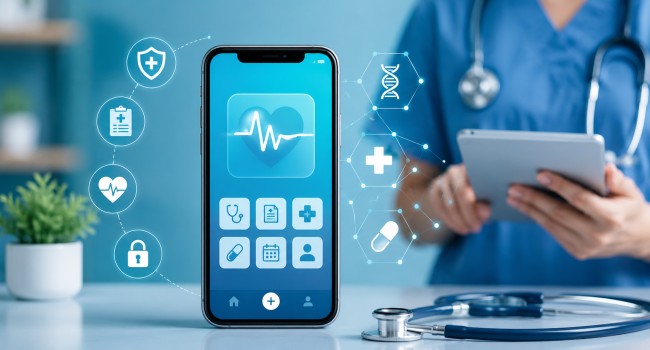
Varieties of applications for healthcare
The health app is a tool that helps people keep track of their health easily using their phones or tablets. Because so many people now use mobile devices, it’s become much simpler to take care of your health with these kinds of apps.
There are two main types of applications:
- for physicians – a calendar reminder on the admission of patients, various reference books, professional training, regulation of appointments, and much more.
- for patients – control of symptoms, notifications, training, communication with doctors, etc.
The presence of such medical applications increases the efficiency of doctors and helps patients receive the necessary information promptly.
Steps to develop a medical app
Various development companies have their program for creating healthcare software but there are basic steps that contribute to the creation of a demanded application.
- Choose a mobile platform
Regardless of the purpose of the medical application, it is necessary to decide on the type of mobile platform. The most common are Android and iOS. Therefore, the company can focus on one of them. You need cross-development if you prefer the application to function on both systems.
- Conducting analytics
Analysis of a commercial project is necessary to make sure that the developed application will be popular. It is essential to know what users need to use health services effectively.
- Interface and functionality
An essential factor in the application’s success is its design development and ease of functionality use. The menu should be easy to use.
- Development team selection
After you have decided on the application and interface, you need to select a team of professional specialists. The development team must work in a coordinated manner and constantly communicate with each other to effectively develop a medical application. An experienced healthcare software company with years of experience is the first place to start. Also crucial to establish a realistic budget during this phase, as development costs typically depend on the app’s complexity, chosen tech stack, and the team’s location.
- Tech stack
When an application is being developed for both operating systems, it is necessary to use a cross-development tool (React, Flutter), and if the application is focused on one operating system, then Swift or Objective-C for the iOS system and Java for the Android system.
- Application creation and testing
The next step is the actual development of a medical application. During this period, a thorough development takes place, considering all the nuances associated with its functionality during use and detecting errors and shortcomings in the program. For this, individual parts are tested, and then the application as a whole.
- Consideration of initial production
There are cases when the first time, it turns out to create a finished full-fledged product. But it will not be superfluous if the products are carefully checked. After all, if shortcomings are found, they can be eliminated promptly before the products are released to the user market.
Necessary functionality of medical applications
If the developer company strives to be a leader in this area, you must follow the current trends that make the healthcare application effective. To do this, you need to provide the following mandatory functions:
- Videoconferencing. It is vital to use video in the application to increase communication between medical professionals and patients – providing virtual meetings and the possibility of remote monitoring.
- Accounts. Creating your profile by registering makes it much easier to use the medical application. And registration should be as straightforward as possible for users.
- Possibility of making appointments. This booking function allows you to schedule online meetings and conduct various consultations.
- Online recipes. The function allows you to get a list of necessary drugs for purchase quickly, and it is also possible to check their availability in the nearest pharmacies.
- Controlling symptoms. The symptom check function provides a sense of comfort, as the user is allowed to monitor health indicators that are familiar with health issues promptly.
- Geolocation. This feature is useful when you need to find the desired address of a medical institution or pharmacy. Getting acquainted with health news and being aware of emergencies near the user’s location is also possible.
- Protection of personal information. The platform’s security and reliability are essential for medical application users. Innovative technologies allow you to provide protection as efficiently as possible.
- Communicative connection. App creators should integrate communication tools, including mobile chats and video calls.
- Smart devices. They provide users with the ability to control many indicators to be able to monitor their health. Specialized sensors ensure it.
In addition to the above functionality, you can integrate artificial intelligence, various reminders, and blockchain technology.
Conclusion
Creating a mobile healthcare application is a complex task that includes many steps. It is choosing an operating system, product analysis, test results, and, most importantly, the need for products for users.
Successful development will require a team of specialists with practical skills in this development area. Health is the main engine of human activity in achieving goals and well-being. Applications for health care provide effective interaction between physicians and patients.
Also Read: