TechMediaToday
Marketing

Should You Buy App Reviews for Google Play?

App Reviews for Google Play

There is a point in every new app launch when the numbers start looking uncomfortable.

Ten downloads. Three ratings. Maybe one review.

Meanwhile, competing apps have thousands of ratings sitting under their names.

That is when buying Google Play reviews starts to look less like a shady shortcut and more like a practical marketing decision. Spend a few hundred dollars, get a batch of five-star reviews, make the app look established, and perhaps the downloads will follow.

It sounds clever.

It isn’t.

Buying app reviews can make a Google Play listing look better for a while, but it does not solve the problems that usually cause a new app to struggle.

Worse, paid or fake reviews can put the app in conflict with Google Play’s policies. Google specifically prohibits manipulating ratings, reviews or installs through illegitimate methods, including fake and incentivised reviews.

So the real question is not whether app reviews can help an app.

They can.

The question is whether buying them is worth it.

For most app businesses, the answer is no.

Why Buying Google Play Reviews Looks So Tempting

Reviews carry weight.

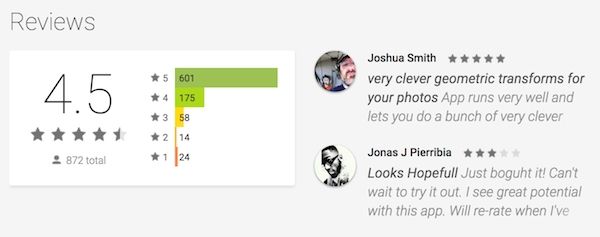
Open almost any app listing and the first things that stand out are the rating, number of ratings, screenshots and description. A product with 4.5 stars from thousands of users naturally feels less risky than one with 3.8 stars from 17 users.

That first impression matters.

A developer launching a new app knows this. The temptation is particularly strong when competitors already have years of accumulated feedback.

Buying reviews appears to solve the problem quickly.

A review seller might promise:

  • 50 five-star ratings
  • 100 positive reviews
  • Reviews from particular countries
  • Ratings spread across several days
  • Reviews with keywords related to the app
  • Packages combining downloads, ratings and reviews

The pitch is usually simple: improve social proof and make the app look more trustworthy.

But there is a major difference between looking popular and actually having users who like the product.

That difference eventually shows.

Google Play Does Not Treat Reviews as a Free Ranking Hack

A common claim made by review-selling companies is that buying five-star ratings will push an app higher in Google Play search.

There is no such guaranteed shortcut.

Google says its app discovery systems consider several signals, including relevance, app quality, user feedback and engagement. Search results are particularly influenced by relevance to the user’s query, while other parts of Google Play use different signals.

That makes sense.

If ratings alone determined rankings, every developer with a marketing budget could simply purchase a large review package and jump ahead of established competitors.

Google has no reason to build a store that works that way.

Reviews can influence how potential customers perceive an app. They are also part of the information Google analyses about an app. But that is very different from saying that purchasing reviews produces a predictable ranking boost.

Anyone selling “guaranteed Google Play ranking through reviews” deserves a healthy dose of suspicion.

The Biggest Problem: Google Play Prohibits Fake and Incentivised Reviews

This part is not particularly ambiguous.

Google’s current Play policy says developers must not manipulate app placement by illegitimate means. Its examples include fraudulent or incentivised reviews and ratings. Google also says developers should earn ratings and installs through a quality app and genuine user experience.

That creates an obvious problem for businesses buying reviews from third-party services.

The service may call them “real reviews.”

The accounts may even belong to real people.

That still does not make the arrangement acceptable if those people are being paid or otherwise incentivised to manipulate the app’s ratings.

Google has been dealing with fake ratings and reviews for years. Its own developer guidance warns against fake, paid and incentivised activity and says systems are used to identify and remove fraudulent reviews.

In other words, paying for reviews is not a clever way around the rules.

It is the thing the rules are designed to stop.

4. What Happens When the Reviews Look Fake?

Not every fake review screams “fake.” Some are written quite well. The problem is the pattern.

Imagine an app receives 150 new five-star reviews in a short period. Many contain phrases such as:

“Great app!”, “Very useful and easy to use.”, “Best app ever.”, “Highly recommended.”

Nothing is technically wrong with any single sentence. Real people write short reviews all the time.

Put them together, though, and the listing starts to look strange.

Real customers are messy.

One complains about the login process. Another praises the design but dislikes the subscription. Someone else mentions a bug on a Samsung phone. Another user loves one feature and says nothing about the rest.

That mixture is normal.

A suspiciously clean wall of praise is not. And users are not as gullible as marketers sometimes assume.

Fake Reviews Cannot Hide a Bad Product

This is where the whole strategy starts to fall apart. Suppose an app has a confusing onboarding process.

Buying 500 reviews does not make onboarding easier.

If the app crashes, those reviews do not stop the crashes. If customers cannot cancel a subscription, five-star ratings will not fix the support problem. If the app drains battery, users will still notice.

Eventually, real customers start leaving real reviews. Then the listing can end up with an awkward split:

Purchased praise at the top. Genuine complaints underneath.

That is not a strong brand position.

Google itself treats reviews as useful feedback about issues such as design, privacy, speed, stability, usability, updates and other aspects of the user experience. Developers can analyse these themes in Play Console.

A genuine negative review can therefore be useful. It tells the product team what is going wrong. A fake positive review tells the team almost nothing.

Are Paid Reviews Ever Worth the Risk?

For fake reviews, the answer is difficult to justify.

The possible upside is mostly cosmetic: a larger review count, a better-looking listing and perhaps a temporary improvement in conversion.

The downside is much broader.

There can be:

  • Removal of suspicious ratings or reviews
  • Policy enforcement
  • Loss of customer trust
  • Money wasted on low-quality services
  • Poor-quality users who never become genuine customers
  • A misleading picture of product satisfaction
  • Reputational damage if the activity becomes public

There is also a less obvious cost.

Management starts making decisions using bad information.

If an app supposedly has hundreds of positive reviews but many of those reviews were purchased, the rating no longer represents customer sentiment. Product teams may miss genuine problems because the feedback data has been polluted.

That is a bad trade.

What About Paying Real Users to Review an App?

This needs a distinction.

Paying people to participate in legitimate user research is not the same thing as paying them to leave five-star Google Play reviews.

A company can recruit testers, collect feedback, run usability studies and ask people what they genuinely think about an application.

That feedback can be extremely useful.

The problem comes when money, discounts, gifts or other incentives are tied to leaving a rating or writing a particular kind of review. Google explicitly lists offering incentives for ratings or reviews as a policy violation.

The safer rule is simple:

Pay for research if needed. Do not pay for praise.

How to Get More Genuine Google Play Reviews

There is no magic button here. There is, however, a process that works.

1. Ask after a useful experience

A review request makes more sense after someone has successfully completed a meaningful action inside the app.

Asking five seconds after installation is usually premature.

2. Fix the problems users already mention

If reviews repeatedly complain about crashes, login issues or confusing navigation, those problems should move up the product roadmap.

A better product naturally creates better reviews.

3. Make rating requests unobtrusive

Google recommends using the in-app review API so users can submit ratings without being pushed out of the app.

The request should feel like a small invitation, not a demand.

4. Ask for honest feedback

There is no need to say, “Please give us five stars.”

A better approach is to invite an honest rating after a positive product experience.

The customer decides what the rating should be.

5. Respond to complaints

A negative review should not automatically be treated as an enemy.

Sometimes the customer is wrong. Sometimes the customer has uncovered a genuine bug. Either way, a professional response is better than silence.

Google recommends keeping replies focused on the issue raised and avoiding requests for a higher rating.

A New App With No Reviews Has a Different Problem

New apps have an awkward starting point.

Nobody wants to be first.

But trying to manufacture a crowd is not the answer.

Early adoption should come from genuine users who actually need the product. Beta testers, existing customers, industry communities and relevant marketing channels can help create that first group of users.

Those people can provide something much more valuable than a five-star rating.

They can explain why the app is useful.

That detail matters.

  • “Great app” tells a prospective customer almost nothing.
  • “Used this to organise invoices for a small business and the export feature saved hours each month” tells a story.

Real reviews contain experiences. That is what makes them persuasive.

Reviews Should Be Treated as Product Feedback, Not Decoration

There is a tendency to treat the review score as a trophy.

4.8 stars looks good.

But the number itself does not tell the whole story.

Google Play provides developers with tools to examine ratings by factors such as country, device type, app version and other dimensions. It also provides review analysis showing recurring topics and issues.

That information can be surprisingly useful.

  • A sudden drop in ratings after an update might point to a release problem.
  • Complaints about battery usage may expose an optimisation issue.
  • Negative comments about registration may indicate unnecessary friction.
  • A cluster of complaints about one Android version might deserve technical investigation.

Those are business insights. Purchased reviews provide none of that.

Final Verdict

Should an app developer buy Google Play reviews? No — not if the goal is sustainable growth.

Fake and incentivised reviews can violate Google Play policy, and there is no reliable formula where buying 100 five-star reviews automatically produces higher rankings or more downloads. Google says app discovery considers relevance, quality, user feedback, engagement and other signals.

There is also a more basic business argument.

Customers eventually use the product.

They do not care how impressive the review count looked before installation if the app crashes, performs badly or fails to deliver what the listing promised.

A better strategy is slower but much harder to break: improve the app, attract genuine users, ask for honest feedback at sensible moments and act on what customers say.

A new app may have only 20 reviews.

That is fine.

If those 20 reviews came from real customers, they are worth more than 500 purchased compliments.

Also Read:

Leave a Comment