Solar installation has never been a walk in the park. Panels are heavy, rooftops are unforgiving, and one wrong move can cost thousands — in equipment or worse, in injuries.
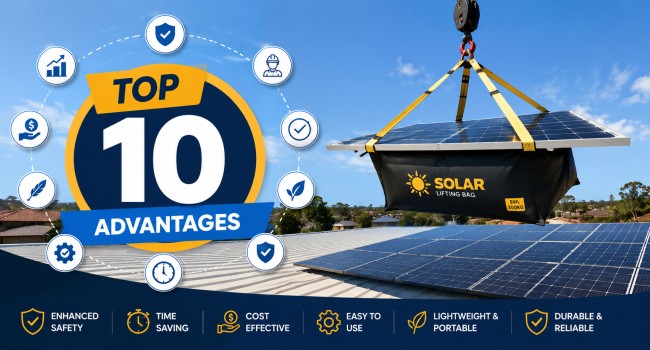
Solar panel lifting bags have quietly become one of the most practical tools in a professional installer’s arsenal. Here’s why they matter more than most people realise.
Advantages of Solar Panel Lifting Bags
1. Drastically Reduced Risk of On-Site Injuries
Manual handling of solar panels accounts for a significant share of construction-related injuries globally. Lifting bags distribute load evenly across the panel surface, reducing pressure points that cause sudden slippage.
Falls, pulled muscles, crushed fingers — lifting bags cut these risks at the source. OSHA’s construction safety guidelines outline manual handling as a primary hazard. This equipment directly addresses that category.
2. Protection Against Panel Micro-Cracks
Here’s something that doesn’t get enough attention: micro-cracks. Invisible to the naked eye during installation, micro-fractures silently destroy panel efficiency over time.
Rigid gripping tools concentrate force on narrow contact zones. Lifting bags? They spread load gently and uniformly. The result — panel longevity improves, warranty claims drop, and clients see better long-term ROI.
3. Faster Installation Timelines
Time is money, full stop. Lifting bags allow single operators to position panels that would otherwise require two or three people working in coordination. Fewer hands needed per panel means more panels installed per day.
Project timelines shrink. Labour costs shrink with them. For commercial installations spanning hundreds of panels, the cumulative time saved is substantial.
4. Compatibility Across Panel Types and Sizes
Modern solar panel lifting bags aren’t one-trick ponies. Designed to accommodate varying panel dimensions — from compact residential units to large commercial bifacial panels — quality bags use adjustable strapping systems and reinforced attachment points.
Whether working with monocrystalline, polycrystalline, or thin-film modules, the same equipment adapts. That flexibility alone justifies the investment for multi-project contractors.
5. Enhanced Load Security During Transport
From the truck bed to the rooftop, panels face multiple handling transitions. Each one is a risk event. Lifting bags keep panels secured during these transitions, preventing the awkward tilting and edge impacts that crack frames or damage junction boxes.
The International Electrotechnical Commission (IEC) standards for photovoltaic modules specifically flag mechanical stress as a durability concern — lifting bags directly mitigate this.
6. Ergonomic Benefits for Installation Crews
Chronic back injuries devastate skilled tradespeople’s careers. Lifting bags typically integrate with crane hooks, vacuum lifters, or manual grip handles positioned at ergonomically optimal heights.
Workers aren’t bending at odd angles or stretching across panel surfaces. Over a 10-year career, that difference in posture and load distribution adds up to something significant — fewer sick days, lower workers’ compensation claims, longer productive careers.
7. Suitable for High-Wind and Challenging Roof Conditions
Flat rooftops are generous. Steep pitches, high-wind corridors, and irregular surfaces are not. Lifting bags with anti-slip grip surfaces maintain secure panel contact even when conditions turn difficult.
Some professional-grade bags incorporate wind-load rated attachment systems specifically engineered for rooftop environments where gusts create unexpected lateral forces. Working on a coastal property or an exposed commercial site? This feature stops being optional fast.
8. Cost Savings Over Time
The initial purchase feels like an overhead cost. Run the numbers differently. One cracked panel during installation — replacement cost, project delay, client trust damaged.
One installer injury — medical costs, downtime, potential litigation. Lifting bags pay for themselves after preventing a single incident. For fleet operations running multiple crews, the ROI calculates favourably within the first month of use.
9. Compliance With Health and Safety Regulations
Regulatory bodies across the EU, UK, and North America have tightened manual handling requirements on construction sites. The Health and Safety Executive (HSE) sets clear thresholds for acceptable manual lifting loads and techniques.
Solar panels routinely exceed safe single-person lift weights. Using certified lifting bags demonstrates due diligence — important during site audits, insurance assessments, and project certifications where documentation of safety practices carries real weight.
10. Scalability for Large Commercial Projects
Small residential jobs forgive inefficiency. A 500-panel commercial installation does not. Lifting bags integrate smoothly with mechanical lifting systems — cherry pickers, cranes, panel carts — turning what would be a logistical nightmare into a coordinated workflow.
Project managers gain predictability. Crews gain rhythm. Clients see deadlines met. The scalability factor makes lifting bags not just useful but structurally necessary at commercial scale.
Final Thoughts
Solar panel lifting bags occupy a specific, high-value position in professional installation workflows. Safety, speed, panel protection, regulatory compliance — each advantage compounds the next.
For installation businesses serious about operational quality and crew welfare, adding lifting bags to standard equipment isn’t a luxury. It’s sound practice.
For further reading on solar installation best practices, the Solar Energy Industries Association (SEIA) publishes regularly updated guidance relevant to both residential and commercial contractors.
Also Read: