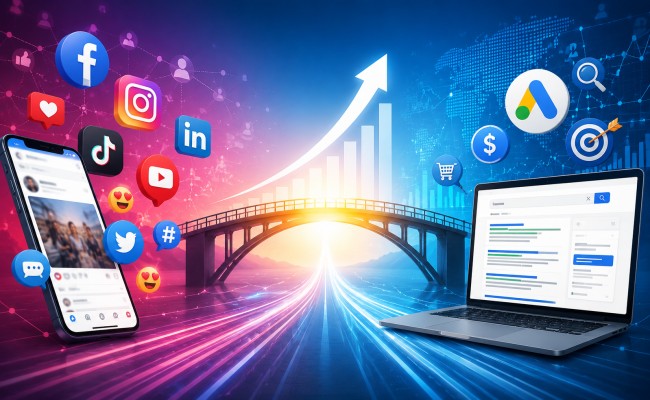
The Australian digital advertising market has evolved significantly in recent years. By 2025, local digital ad spend reached AUD $18.4 billion, with budgets heavily concentrated across two primary acquisition channels: social platforms and search engines.
While many businesses still treat these as completely isolated silos, the most effective modern marketing frameworks actively bridge the gap between social media awareness and high-intent search capture.
When brands synchronise their outreach, they create a compound effect that amplifies overall campaign performance.
The Halo Effect of Social Media on Search Behaviour
Consumer journeys are no longer linear. According to recent industry reports, 58 percent of consumers now discover new businesses via social platforms. This shift effectively bypasses traditional search engines as the initial touchpoint for brand discovery.
Furthermore, Australian digital video advertising has permanently surpassed traditional broadcast television, signalling a definitive change in how brands generate top-of-funnel awareness. Mobile devices play a massive role in this shift, as users constantly scroll through feeds during their daily commutes.
However, this discovery phase on platforms like Instagram, LinkedIn, or TikTok rarely results in an immediate purchase. Instead, it creates a powerful halo effect that directly fuels future search queries.
Consumers see a compelling video, remember the brand, and later turn to Google when they have the budget or immediate need to buy.
Because navigating these subsequent queries is highly competitive, many local businesses rely on specialists in paid search Sydney to ensure they capture the demand initially sparked by their social campaigns.
A recent Meta for Business case study demonstrated exactly this phenomenon, revealing that exposure to top-of-funnel social ads drove a direct 20 percent lift in Google paid search traffic for the brands involved. This data proves that social media marketing does not operate in a vacuum. The interest it generates inevitably spills over into search engine activity.
Capturing Bottom-of-Funnel Demand
Building brand affinity on social networks is only half of the acquisition equation. If your search engine presence is weak, competitors will inevitably intercept the very demand your social media budget just generated.
Google maintains a dominant 91 percent share of the Australian search market, making it the undisputed destination for capturing bottom-of-funnel intent.
Navigating localised, highly competitive search auctions requires significant technical expertise and constant bid adjustments. Because of this complexity, many ambitious brands choose to manage their community engagement and content creation in-house.
They focus their internal resources on building authentic social connections, while relying on dedicated experts to handle the highly technical conversion mechanics required to harvest local leads.
When a potential customer searches for a brand name or a related product after seeing a social ad, a well-optimised search campaign ensures the business appears at the absolute top of the results page.
Executing a Unified Cross-Channel Strategy
To successfully integrate these two distinct marketing disciplines, business leaders must adopt a holistic view of the customer journey rather than obsessing over isolated metrics.
Recent data validates this approach, showing that brands running unified multi-channel campaigns achieve a 30 percent higher lifetime ROI from their customers compared to those relying on a single channel.
Bridging the gap between social interest and search intent requires a few fundamental strategic adjustments to ensure your channels complement one another:
- Aligning Messaging and Creative Assets: The ad copy and landing pages in your search campaigns must directly reflect the core promises, language, and visual branding presented in your top-performing social content. Consistency builds consumer trust and drastically increases conversion rates.
- Implementing Multi-Touch Attribution: It is critical to move away from outdated, last-click attribution models. By stitching together paid social data and search metrics within a 30-day window, brands gain a much more accurate and defensible picture of how social awareness actually influences final search conversions.
- Defensive Competitive Benchmarking: Monitoring your own performance is only part of the equation. You must also keep a close eye on rival businesses that might try to intercept your audience when they search for your brand.
To effectively monitor these rivals, professionals recommend using an auction insights report for better PPC competitor analysis. This enables marketing teams to track exactly who is trying to poach their hard-earned traffic and adjust their bidding strategies accordingly.
The line between social discovery and search intent is no longer clear-cut. By treating social networks as the primary engine for audience awareness and search engines as the ultimate mechanism for conversion capture, businesses can unlock sustainable, measurable growth in an increasingly fragmented digital landscape.
Also Read: